I have been operating my EP600 (off-grid parallel) with AC PV and would now like to expand it directly with DC PV, which I connect to the EP600.
Currently, the maximum feed-in power is limited by regulatory at 4 kW, which is the maximum I am allowed to feed into the grid. How/where can I set the EP600 so that the DC PV surplus that goes into the grid, when the battery is full, is throttled to 4 kW?
With the AC PV inverters, I can set this directly on the inverters, but where is the setting for this on the EP600? Note: I do not mean the battery feed into the grid, as this is not permitted by the grid operator, but only the PV surplus feed!
1 Like
@BLUETTI_CARE just read an similar Topic: Dual EP900, pv export
I think it’s the same issue. I also use two EPs (EP600 vs EP900) and want to regulate/limit the PV export.
But the settings in this article look completely different from mine.
.
Left side, black menu is from the EP900, mine is EP600, right side, white menue:


.
I also use Pro Mode in App, but why looks my App different then the other?
Don’t the EP900 and EP600 work the same way? Can’t I regulate PV export with the EP600 in the same way as with the EP900?
A quick update from me: Got a reply from “Mike” yesterday.
The EP600 really does have different settings for limiting PV feed-in.
- [Working Mode] is set to “self consumption” by default, but “Time of Use” must be deactivated.
- This means that “Feed-to-grid” now only controls PV feed-in, but no longer controls the feed-in of battery power into the grid.

Since I haven’t expanded to DC PV yet, I tested this with my AC PV. Limiting the PV feed-in also works with AC PV. With these settings, I export exactly 600W into the grid as soon as the SOC reaches 94%. The PV export stops again as soon as the PV no longer supplies power.
Hi @SigiKa, Thank you for providing the detailed information.
We have consulted the technical department regarding this matter and will contact you as soon as we receive a response.
Hi @SigiKa, I appreciate your kind understanding and patience.
We have now received a response. Regarding your request, please set the “Feed Into Grid” option to 4000W.
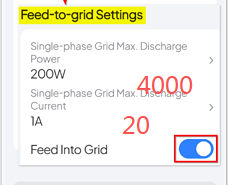
Hi @BLUETTI_CARE , Thanks for the tip. My settings were for the first test so as not to exceed the limit (800W) of the “balcony power plant”. I still have to wait for approval from the grid operator before I can feed in the maximum 4 kW.
Hi @SigiKa, you are welcome! Thank you for letting us know.
We hope everything goes smoothly from here!
Please don’t hesitate to contact us if you need our assistance.
Hi @BLUETTI_CARE ,Today, for the first time, I tried letting the AC PV and DC PV charge without throttling and then feeding the entire surplus into the grid.
In doing so, I noticed the following behavior:
a) Up to 100% SOC, both the AC inverters and the EP600, as a DC-PV inverter, operated at full power.
b) However, upon reaching 100% SOC, the EP600 completely shut down its own DC string on PV1; the modules were only operating in idle mode.The remaining power is now only AC-PV.

.
What did I set incorrectly, or is this still a bug in the EP600? I have disabled the setting described above for throttling the feed-in power, yet the EP600 still exhibits this incorrect behavior. PV surplus should go into the grid, right?

.
PV1 is in idle mode, why?

.
The AC-PV Inverters are going on with full power

.
Time of use and feed-to-grid are turned off, so there shouldn’t be any further throttling, right?

.
P.S.: When I set Feed-to-grid to a higher value and activate it (10,000W), the battery begins discharging into the grid, but the DC string on the EP600 remains off until the SOC drops to 99% or below; only then does PV1 become active again, but only until the batteries are fully charged… (The second arrow in the first image above indicates the brief activation of the PV1 string on the EP600)
For reference, I have EP13K (2 in parallel) connected to an AT1, with 8KW AC coupled PV array connected to the AT1, so hopefully this works for you. In order to keep exports for the AC coupled PV when SOC reaches 100%, and prevent cycling of the AC coupled PV, I turn On ‘Feed to Grid’, but set the Power/Amps to ZERO. From my experimentation, the Feed to Grid numerical values only affects the DC PV connected to an EP, but the Feed to Grid switch affects both AC and DC PV. So setting Feed to Grid to ON allows me to export, but setting the values to zero means I feed ZERO DC PV power to grid.
Hopefully this works with the EP600, it may be this is a unique operating characteristic of the AT1.
1 Like
Hi @CurtisNolting76,
So far, I have observed the same behaviour with both of my EP600 units running in parallel. As soon as ‘Feed to Grid’ is switched on, but the power value is lower than the AC PV output, the EP600 reduces the feed-in from its own DC PV.
.
I have therefore tried various settings to get the EP600 to feed in the entire surplus (AC + DC). It cannot influence the AC-PV portion, as this is controlled by other inverters.
I am currently using the following Feed-to-grid setting, which finally feeds the entire surplus into the grid:
- Single phase max. Current: 20A
- Single phase max. Power: 4,500W (3 phases = 13.5kW)
The solution was that the max. power value must be greater than AC + DC PV; only then is the entire surplus recognised, as the EP600 also measures the feed-in from the AC PV inverters and adds it to its own DC string!
.
A nice side effect I also noticed is that as soon as I reduce the SOC max. value (e.g. 90%), the surplus starts earlier in the day and I can finally prevent my batteries from being charged to 100% every day. As soon as the SOC value is reached, charging stops and the surplus feeds into the grid.
Hi @SigiKa, thank you for your update.
@CurtisNolting76’s suggestion is very helpful.
We have also submitted your feedback to the technical manager for analysis.
1 Like
Hi @SigiKa, we have now received a reply from our engineers. This is caused by excessively high PV input power.
The EP600 supports a maximum feed-in power of 6kW. Once the batteries are fully charged, PV input will stop automatically.
Hi @BLUETTI_CARE, thanks for your reply.
I don’t think it’s that simple to explain. It can’t be due solely to the excessive PV input. The EP600 has a maximum feed-in power of 6 kW, okay. I have two EP600s in parallel mode, which means they can charge twice as much, or 12 kW in total.
My “all-time high” from the PV modules was 9.5 kW last week, so the feed-in shouldn’t actually be hitting its limit, right?
It makes sense that charging stops when the batteries are full, but why not just feed the excess into the grid instead of deactivating the EP600 inverter?
Hi @SigiKa, based on your situation, we suggest enabling the Feed-to-grid Settings in the app, which should help.
