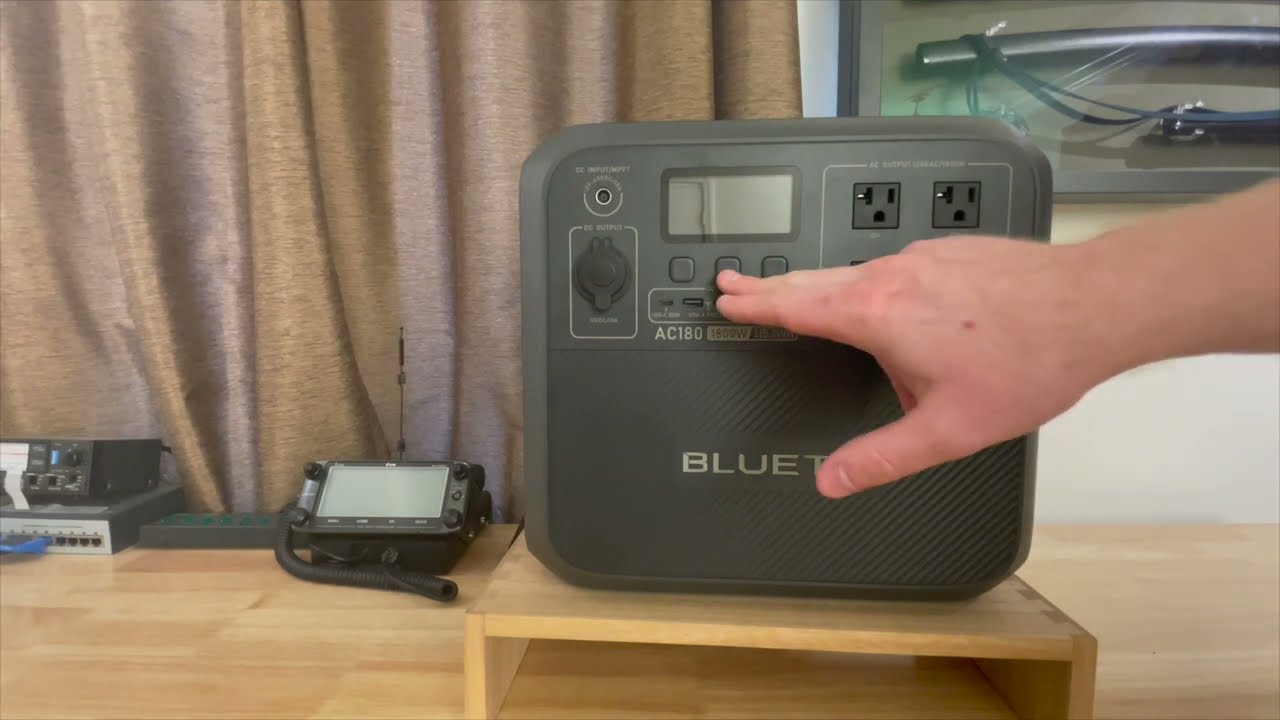
I just wondered if others have done capacity tests on their Bluetti power stations and what kind of results they are getting. I have several Bluetti stations that I have purchased over the course of several years and I recently started capacity testing them (on the AC output side) by charging them to 100% and then putting a cheap power meter in the AC outlet and running various loads until the power station drains and shuts itself off (then reading total watts output from the meter).
My results have been interesting (especially on brand new units). Some examples:
Brand new Bluetti Elite 10 - 97 watts out of rated 125 watts (77.6%)
Brand new Bluetti Elite 30 V2 - 212 watts out of 288 watts (73.6%)
I have also tested several other stations of various models and ages but I always got around the 70% value.
I see reviewers getting 80 to 90% and sometimes more so I just wonder how they are able to achieve those values and if anyone else has gotten those numbers as I find it to be an interesting topic.
Watch this video. It’s a different model, but you’ll understand why different stations and measurements have different efficiencies. The channel’s author conducts an in-depth study of Bluetti charging stations.
In short, the efficiency of the AC and DC outputs varies under different loads. You can pause the video and view the graphs.
Different stations are also compared under the same load levels.
I have also tested several other stations of various models and ages but I always got around the 70% value. I see reviewers getting 80 to 90% and sometimes more so I just wonder how they are able to achieve those values
Your watt meter does not factor in power lost from DC side to the AC side (inverter losses) as well as general system overhead on DC side to run things like BMS, etc. The load they are using is also likely appropriately sized for the inverter and clean power as well. For larger inverters, the lower your AC load the more inefficient your results will be (inverter overload/system sizing mismatch). For smaller inverters the closer you get to max load the worse it will get (again inverter overload).
From a user testing perspective it depends on what boundaries they used to classify what “AC Efficiency” means. If you include everything from battery to plug, you are effectively saying what the overall system efficiency is, not just AC. Those numbers will be lower. If you are just calculating how many watt hours you gained, then figuring out what the inverter overhead is and coming up with a calculation you are, the numbers will be higher.
So what metrics are they including in their overall “efficiency numbers” is important context. Actual numbers aside, the numbers themselves are slightly misleading because your common sense brain would think that low numbers are BAD and higher numbers are GOOD right? In reality it’s all about RUNTIME. A lower constant load may be less efficient on a Bluetti Elite 100 v2 compared to the Elite 30 v2, but the overall runtime will still be higher. 40% of 40W is a lot less than 40% of 400W. So if an Elite 100 V2 was ONLY 60% efficient at a 40W load, and the Elite 30 V2 was 75% efficient, the Elite 30 V2 would pull 40/0.75 or 53W and the Elite 100 V2 would pull 40/0.6 or 66W from battery. Assume you wanted to run this appliance for 8 hours. The Elite 30 V2 would consume 424Wh. The Elite 100 V2 would consume 528Wh. But remember you can only get 200W MAX from PV input of Elite 30 V2. At best you are recharging that power station at 85% charging efficiency and assume you get 175W out of your panel, that would effectively give you about 150W back. So 424/150 = 2.82 hours to top off the power station. The Elite 100 V2 can string together two PV350s at around 36V@20A in peak sun or about 720W, so 85% efficiency on that is 612W. 528Wh/612W = 0.86hrs (~52 minutes). Huge difference if you only get 2 hours of peak sun that next day. What you actually want to do is size your inverter to your needs. I care more about solar potential and battery potential than getting an extra 10% from my inverter, especially if its means I’m going to get 50% less runtime.
Very interesting information so far. As an aside from the video referenced above (slightly different topic I guess), the types of UPS were interesting. If you are using a station in Offline UPS mode, I noticed that it is still cycling the battery (albeit probably a lot slower than when acting as an online UPS) because when I have used them in offline UPS in the past, the battery will still charge when the SOC drops to 99% from just sitting there. I always wondered how detrimental to the overall life of the unit it might be to use it as a full time UPS? Would it take several years off the lifetime of the unit just because the battery stays full and has to charge a little from time to time? A lot of good information in that video.
My simple analogy re power station efficiency is; Think of it like a vehicle, if you drive hard and fast, you use more fuel, slow and less throttle is more efficient. Therefore to state a MPG (or litres per 100kms) is subjective.
So as @sealy1986 notes, when posting results, you need all of the data i.e. the load, consistency, temperature and all other factors to achieve that figure. A different test will give different results in different conditions.
This does not mean that there is something wrong, just different, lol. Energy IN, does not = Energy OUT, when something is done to it inbetween…