Hello, @BLUETTI
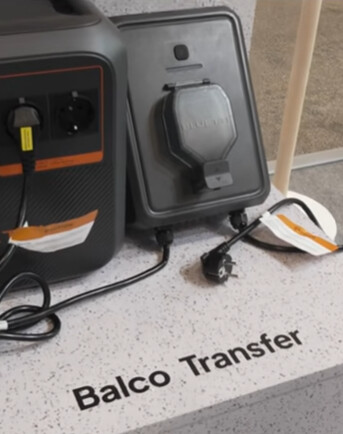
I’m very interested in this new product that’s starting to be shown at trade shows: the “Balco Transfer” (image below). Do you have any specifications? In particular, is there a system equivalent to a Shelly meter/Current sensor that allows for modulating the power injected into the outlet to achieve “zero injection” into the grid? What is the maximum power that can be injected ? And what is the AC output/AC input efficiency? Thank you!
Thank you very much for your very detailed response. I have a follow-up question: would it be possible to go beyond 800W, if the user is warned, fully aware of the risks, and has checked that his electrical wiring (AWG/mm²) is sufficient to avoid the risk of overheating ?
Looks great. I am very interested in this product. In the UK we are currently passing legislation to support plug in solar. Please keep the UK in mind and hopefully the Balco Transfer can launch here as well. The last micro inverter didn’t get a UK release. Perhaps Bluetti can time this well for early introduction to the UK when the new rules come in. A lot of people seem interested in this technology.
Edit-
It would be even better if it had the capability to connect to the expansion battery or the Charger 2. I have a Shelly Pro 3EM so am excited about the news that Shelly could be supported. Let me know if you need any UK testing I have an Apex300, AC300, Elite100 and Charger 2 and Bluetti gold member now .
Definitely interested in this assuming the UK plug in solar regs get updated by the end of summer as promised.
Curious about two things however
Do you have any sort of efficiency numbers. I’m assuming that the unit is doing some level of magic rather than converting via DC to feed the grid tie but what is the efficiency like
Can I plug it into the wall socket and plug a car V2L port into it (ie can I use it and an EV charger as a cheap V2H/V2G alternative ?)
Disappointing that it seems to have no support for standard existing power meters and that they too don’t support a simple wifi CT clamp and taking the voltage info from the fact it’s plugged in. That makes it much harder to install in the UK as our regs don’t permit anyone but a qualified electrician to fit things into the consumer unit/main panel.
Still want to know what the efficiency looks like. Bluetti really ought to give some estimate on that. It’s not like the day it comes out someone isn’t going to measure it and do a youtube video 8)
I ordered a Balco Transfer unit, and as soon as I receive it, the first thing I’ll do is measure its efficiency. Indeed, for it to work, AC must be activated on the bluetti, so there’s already an initial loss… and then the Balco Transfer unit, and I don’t know if it performs an AC-DC conversion and then AC conversion (synchronous with the grid) or if it simply shifts the phase of the AC coming out of the Bluetti to be in sync with the grid, without requiring DC conversion.
For the electrical panel: you still have the option of installing a compatible smart meter-outlet between the electrical grid and the electrical equipment, and the balco transfer will inject only the power consumed as measured by the smart outlet.
Will a version of this be coming to North America? I imagine it is more difficult to engineer for NA since we use 120/240V split phase and most portable power stations only output 120V.
If they launch in the UK I am thinking of using the Bluetti Balco AC when I am home and the AC would be on anyway, and using my PowerStream when I am out or sleeping when the AC would typically be off.
When using a Charger 2 outputting from a B300K to power a PowerStream the Charger 2 input is about 10% higher than the PowerStream input due to DC conversion losses which seems somewhat similar to the AC conversion and self consumption losses on a modern system like the Apex300.
It seems quite good but like you say we are now using double inverter so if this is the only thing being powered it could be quite wasteful. I would have preferred a bit better efficiency around the 100 watts mark as lot of households will be around that with typical background devices. I hope they do a UK launch in July so I can get one.
A better design would have been P090D to Balco Transfer so that the DC to AC conversion is only happening on the Balco transfer, but I can see why that wouldn’t be so commercially viable for Bluetti.
So these are the existing options for using Bluetti Power stations and expansion batteries with plug in solar.
Option 1 - B300K/Apex300 to DC Hub to PowerStream or alternative micro inverter. DC voltage is converted from 53V battery voltage to 24V. Even with the Anderson connector and a fuse block you can’t power both Micro Inverter inputs due to issues with reverse current flow but the voltage is slightly higher at 26V volts so maximum output power is about 330 watts (26V*13A). This seems to be the most efficient and easiest to automate if you have an Apex300.
Option 2 - B300K/Apex300/AC300 etc to Charger 2 to PowerStream. The Charger 2 connects with the P090D and outputs to the PowerStream using the CHG (Power Station Output) The voltage and output wattage can be manually selected I settled on 46V and 400 watts for best performance. The Charger 2 is noisier than the DC HUB and slightly less efficient but it has more voltage control and solar input. This is a really good option for a stand alone system with B300K, Charger 2, solar panel and PowerStream.
You can combine Options 1 and 2 and use both inputs on a PowerStream as long as the source power stations are separate to avoid reverse current flow and then you can get 730 watts output if both are enabled. What I prefer is to balance the output depending on charge levels of the separate power stations.
Option 3 - Balco Transfer from a AC plug on a Bluetti Power station. You get the full 800 watts from 1 device so it is advantageous for higher power uses but it would be the least efficient if no other devices are being powered from the power station, or at lower constant output levels for example constant 100-200 watts.
For the “Balco Transfer” setup to make sense, you need a few things: 1) Bluetti batteries and solar stations designed for portability—units that would otherwise sit idle when you aren’t on vacation. 2) You definitely need solar power; even though the efficiency isn’t 100%—far from it—solar energy is essentially “free” (given how much panel costs have dropped), so the efficiency losses caused by the solar station’s inverter and the Balco Transfer unit are acceptable. Note that if you feel the efficiency is poor at low loads (below 200–300W), you can rig up a system to activate the Balco Transfer only when your household grid consumption exceeds that 200–300W threshold. You can do this either by using a smart meter on your home system or by plugging a specific appliance—one whose grid consumption you want to offset—into a smart plug; ideally, you would then use Bluetooth to turn off the Bluetti generator’s AC output when home consumption drops below 200–300W, and automatically switch the AC back on only when consumption exceeds that level.
@BLUETTI
Based on what I mentioned earlier, I suggest two smart features and one essential feature you could add to the Balco Transfer (which is already a truly smart and well-designed product) :
A configurable threshold for electrical power drawn from the grid (via the S-meter or the S1 smart plug); this threshold would trigger the Balco Transfer to inject power into the residential grid only when grid consumption exceeds that limit.
Additionally, you could implement an “energy-saving” mode that automatically disables the Bluetti generator’s AC output (i.e., turns AC off) when the Balco Transfer is not injecting energy into the résidential grid, thereby improving efficiency.
You have likely heard this before, but a hybrid mode combining “self-consumption” and “custom” modes is essential. The idea is to be able to schedule specific time slots for activating self-consumption mode (i.e., grid injection) and others for deactivating it. For instance, during periods of very low electricity price, I might prefer not to inject power into the résidential grid but instead charge the Bluetti batteries; conversely, during high-price periods, I might want to inject power into the grid. This option is truly indispensable.
We have needed proper time scheduling on the Bluetti App for all devices for a while. I hope that can be added at some point it would make it a lot easier to set up time schedules for those of us on dynamic energy tariffs. The Bluetti HA integration now lets me do it for the Apex300 and DC Hub as long as it is connected to the Apex but they are not thinking of adding the Charger 2 anytime soon. I hope the Balco transfer gets added soon.
During the Winter before I had proper Home Assistant control for the DC hub I used a smart plug on a timer on the Micro inverter plug. That works as a switch to stop power injection during cheap energy times although it is not ideal and does nothing to stop the power station inverter unless that can also be scheduled.
 .
.
