Of course I can comment:
1-I have no idea with regards to your pump, what it needs power wise when you are away the same as you and could only make an educated guess with regards to which model may be appropriate.
2-It seems that you are very knowledgeable with regards to electrical power but somehow “forgot” to inquire about the standby power drain (which any electrical device has) of the device you purchased. Going by the Bluetti supplied standby loss numbers above I would think that you could expect around (4,000 wh hrs X 90% efficiency rate divided by 22 watt hours of the AC on) 6.8 24 hours days at room temperature with no internal fans coming on. Not sure what sites you have been reading up on but over the past several years I see many discussions regarding standby power losses. In fact…the chart supplied by Bluetti above was made and published as a direct results of customer questions regarding standby losses.
3-With regards to not being able to charge again when 0% state of charge is met…This applies to customers who deplete their unit to 0% and do not recharge right away. As in days, weeks or months sitting with 0 SOC. The unit at 0% state of charge continues to operate in the standby mode which depletes the battery to a point where the battery mgt. system (which requires power to operate) can no longer operate and start up to recharge the battery. I personally run my portable units to 0 frequently and have never had an issue with recharging but I do understand that I need to recharge without days or weeks of delays. (Try running an automotive battery to 0%, let it sit a month and try to recharge) Proper battery care is well known and discussed on many forums from all manufacturers. This is not a brand specific issue but general battery care.
With regard to your last paragraph, again these are not brand specific issues as physics are again at play. I am not sure what you expect Bluetti to do to come up with a fix. No matter which model or which brand, there are limits of operation and run time that apply. You can certainly add additional battery capacity but the overlying issues you bring up will still be there but your expected run times will increase.
Before I even contemplated buying a BlueTTI, I was well aware of internal energy drain to power various electrical components, including a BMS. But BlueTTI did NOT provide me (the market) with their actual drain figures, when I bought my original 200MAX early last year. Now, many months later, BlutTTI says 20 watts per hour is an acceptable figure, four times as high as I would have expected to be. I don’t buy the notion of a power fan need with no external load on it, and I don’t buy the notion that the inverter is converting DC energy into AC when there is no AC load on it. See my point?
And having said that… my unit is running over 40 watts/h, with no external load on it. Thus causing the simple request for BlueTTi to provide a fix. The drain is too high.
With respect to BlueTTI support, Mods and users telling us not to discharge our batteries to 0%…how does one prevent their inverter from performing such a feat during a power outage and you are out of the country? And if you are indeed home during a discharge…does one have to babysit the unit for countless hours to make sure it doesn’t fall below the critical level of 10%, but hopefully low enough to recalibrate?
But you are the first person to provide feed back on this dilemma, and suggest that it is a non issue if you recharge the 0% battery in short order. In may case…that would be the case. For if my sump pump for example, does completely discharge the battery during a power outage, the inverter/battery will attempt to recharge immediately upon the grid going back up. So this is good news…if true…and I thank you for stating that. (btw, I will have another DC backup pump in the pit on a double marine battery and trickle charger) The BlueTTI was to give me the peace of mind I was missing the previous years of use.
And now I complain as to why BlueTTI does not provide an automatic fail safe at lower battery discharges, as whole home Power Walls do and similar larger scale home products. And call it a 1,800Wh battery instead of a 2,000Wh battery. That I can live with. Not scaring us into trying to figure out how to stop our load discharges at 10% to prevent product damage…whether we are at home or away! See my point? It’s crazy to put this onus on the user.
And which model would that be? Physics have not changed in the past couple of years. Perhaps you know of a competitive make and model which possesses the idle efficiency you think exists. By the way, I understand your point but not necessarily agree with the statements. The fact is that the performance you think should exist is not out there with current technology or at a price that is marketable. Should BLUetti post idle consumption and real world battery capacity in its specifications and documents??? Sure that would be an improvement. As one of the non BLUetti employee moderators on this forum I see a significant qty of lack of capability and understanding about power stations and electrical concepts to a large degree (not saying that is you) and this is the primary cause of issues and dissatisfaction. There are a huge qty of users that purchase and have no issues and make up the vast majority of users. I was mostly ignorant regarding specs and capabilities a few years ago but I find the more I know, the more useful the equipment is to me. The models offered today vs just two years ago have major improvements in features and usability and I am thankful for that. My wallet less so.
According to the data mentioned above, if you keep the AC output on, the no-load consumption will be 22W, which means it will be 1584 Wh loss for 3 days. 1584 Wh/2048Wh=77%. So the consumption is normal.
As you would expect, the loss when the AC output is on is 5-6W. We are sorry that there is currently no product with such a small loss for AC200MAX level inverters.
As always, thanks for the replies. But I don’t think you understand that I didn’t loose 38% in 3 days, but 62%. The batteries drained from a full charge of 100% down to 38%. And that is with a B230 connected.
So in other words, 2,480 watts were used by the unit in idle mode. (62% of 4,000w). Or 827 watts per day. Far higher than your suggested acceptable levels.
Hello
As you are leaving soon, I believe we have given you very good advice, a simple and quick solution to implement: keep the charger plugged into the AC200MAX.
You are right to point out that this solution is not perfect, because if the power outage lasts too long, and the AC200MAX turns off because it is empty, then it will not turn back on to recharge even if power to your network is restored (and you have to be able to put AC “on” to be able to do “pass through” again)
For this, there is a possible solution (a bit complex though) : an AC-DC power supply connected to the solar input of the AC200MAX: when the electricity in your network is restored, the AC-DC power supply provides a voltage (and if it is high enough) to the DC Solar input of AC200max, which can wake it up to recharge. If you have a second (old) phone that has Bluetooth and connected to your WIFI or telephone network, you can install an application such as “teamviewer” to be able to take control of this phone next to the AC200max remotely (with your smartphone, to be able to put AC on ON -via the bluetti app on the old android phone - to rearm your backup ).
And if you want to be able to automatically turn the AC ON without needing to intervene manually remotely (teamviewer) when it turns back on when the network is restored: it’s possible. I can give you a piece of code/macro that runs on an automation application “Macrodroid”, to be installed on an old android phone with bluetooth. This application can automatically turn AC on when the AC200MAX wakes up.
I just wanted to clarify a point in your post here, regarding the battery state of charge for the AC200Max (and all of the Bluetti power stations). There is a built-in safety capacity for the batteries, so when the charge displayed is 0%, the batteries still have a capacity of about 10% left, and the BMS makes sure we can’t use that safety buffer (it turns off). Having said that, this is the reason the unit needs to be charged within a period of time so that the batteries don’t actually drain down to 0%. There is a similar safety buffer for the batteries at the 100% charge level.
And regarding the inverter converting DC to AC when there’s no load, well, yes it actually has to. Sure, there’s no power/current to a load, but the AC voltage needs to exist or a load cannot turn on. That conversion process is what takes up a large portion of the idle power drain of the inverter (22 watts), vs having the inverter off (5.8 watts). The inverter itself is a load on the batteries when it is on, in the same way a stand-alone inverter would be a load on a battery it was wired to.
hnymann, thank you, but a true home backup solution will not allow itself to become damaged during an extended discharge, during an extended power outage……which appears to be the case with some BlueTTI users. It will indeed safely shut itself down, but will most definitely allow itself to be automatically recharged when the source becomes available (typical pass-through setup)……such as the grid going live again. (Advanced ‘fail safe’ measures of both a BMS & EMS)
A true home backup solution does not need to be babysat. I’m still waiting to hear from BlueTTI tech support to see if this is such the case with their products.
And I continue to wait (with great frustration) to hear from them as to why I have a ‘no load’, idle draw on my batteries of 36 watts per hour, when they posted a chart stating 22 is their acceptable level.
I think your bigger issue, unless you have solar , is that once the power is out and the BLUETTI shuts down. It will NOT turn the AC outlets back on when power is returned. Leaving your sump pump off until you return home and turn on the AC outlets or possibly connect to the BLUETTI remotely and turn on the AC outlets.(assuming you have it connected to WIFi and the BLUETTI charges
For what I have read, the solar will trigger the BLUETTI to start charging
Since I was going to use mine as a backup for WiFi and network and without WiFi, I just purchased a APC ups
Your quote tjohnma – “It will NOT turn the AC outlets back on when power is returned.”
Well, so much for a reliable backup solution. Why does BlueTTI call this AC200MAX Power Station a Home Backup System? For $4,000, I fully expected a simple EMS (Energy Management System) that most BESS’ have these days! I don’t feel it is my job to somehow set up a secondary Wifi switching system for continued backup service once the grid comes back on.
@BlueTTI – can you please address these worrisome concerns. Here is a summary….
Setup notes – I do not use solar. Nor DC output. Bought for the sole purpose of home energy backup during a power outage. There is a B230 connected to this AC200MAX. System is always maintained at room temperature. Set up as a “pass through”.
Issue #1 – testing has proven that my batteries drain at the rate of 36 watts per hour in AC output ON mode, with no load….while simulating a grid outage and no charger connected. For further details, please refer to all my notes above.
Issue #2 – there is far too much user feedback on the possibility that the Power Station will not automatically recharge…should the batteries drain to 0% during a power outage…once the grid comes back online. There appears to be some risk that the unit/batteries will be permanently damaged. This is not acceptable for a backup solution, for the purpose of maintaining a working sump pump, freezer, fridge, etc….while on holidays, or away from the home for periods of time.
I don’t recall reading any of this in your list of “Features” or “Warnings” when I purchased the system.
Please push firmware update when available, but I will not be back home for two months before I can install it and perform a new test….energy flow and capacity.
@Murray
The positioning of AC200MAX is as an off-grid power station without UPS function. Some forum members have done this, and I have seen relevant cases, but BLUETTI has not promoted it as a home backup system. In addition, energy storage products on the market do not automatically turn on the AC output of the device. There may be hidden dangers if the AC output is automatically turned on. For example, if a user is connecting the machine’s output wiring, and the machine automatically turns on the AC, there is a risk of electric shock.
The current price of AC200MAX is $1499. If you are unsatisfied with its performance, I suggest you consider BLUETTI power stations with UPS and WIFI functions.
@BlueTTI - I’m starting to resent being put in this constant defensive position. Much of your commentary is flawed!
With respect to whether BlueTTI markets their AC200MAX as a home battery backup? You do! I am Canadian and use your Canadian .ca site. And if you go to your website menu at the bottom of the page, you will find a Products link to your “Home Power Backup” options…
The very first image you see is an AC200MAX. But nonetheless, when you click on Portable Power Stations, the very first description you see is “BlueTTI AC200MAX Home Backup”.
I am most definitely not expecting a “Whole” home backup system. But I fully expect your labelled “Home Power Backup” products to power home appliances, such as a fridge, freezer and sump pump after the power outage with recharging capabilities.
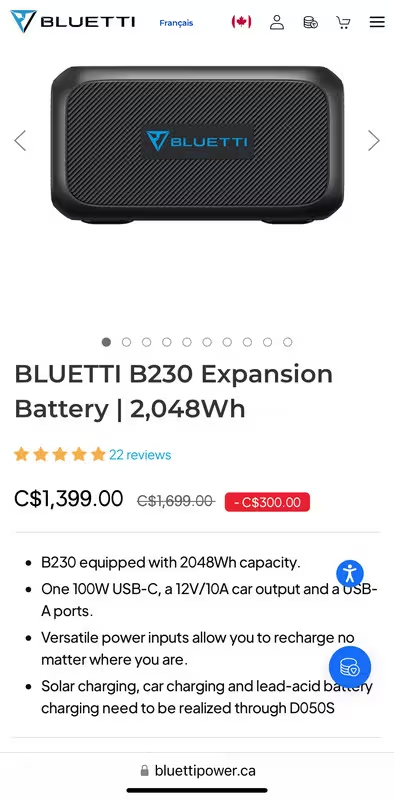
With respect to my stating $4,000 for my BlueTTI backup system…it absolutely cost me $4,000. I paid $2,099 to BlueTTI for my AC200MAX, and I paid $1,399 to BlueTTI for my B230. And you charged me 13% tax (as you should). That total comes to $3,952.74.
I think we finally got to the root of the problem. You were expecting a whole house UPS system with auto changeover to the AC200 max. The AC200 max is a portable power station that be configured for a variety of uses but being a UPS it is not.